The 2026 Expansion: What It Means When Smart Money Doubles Down
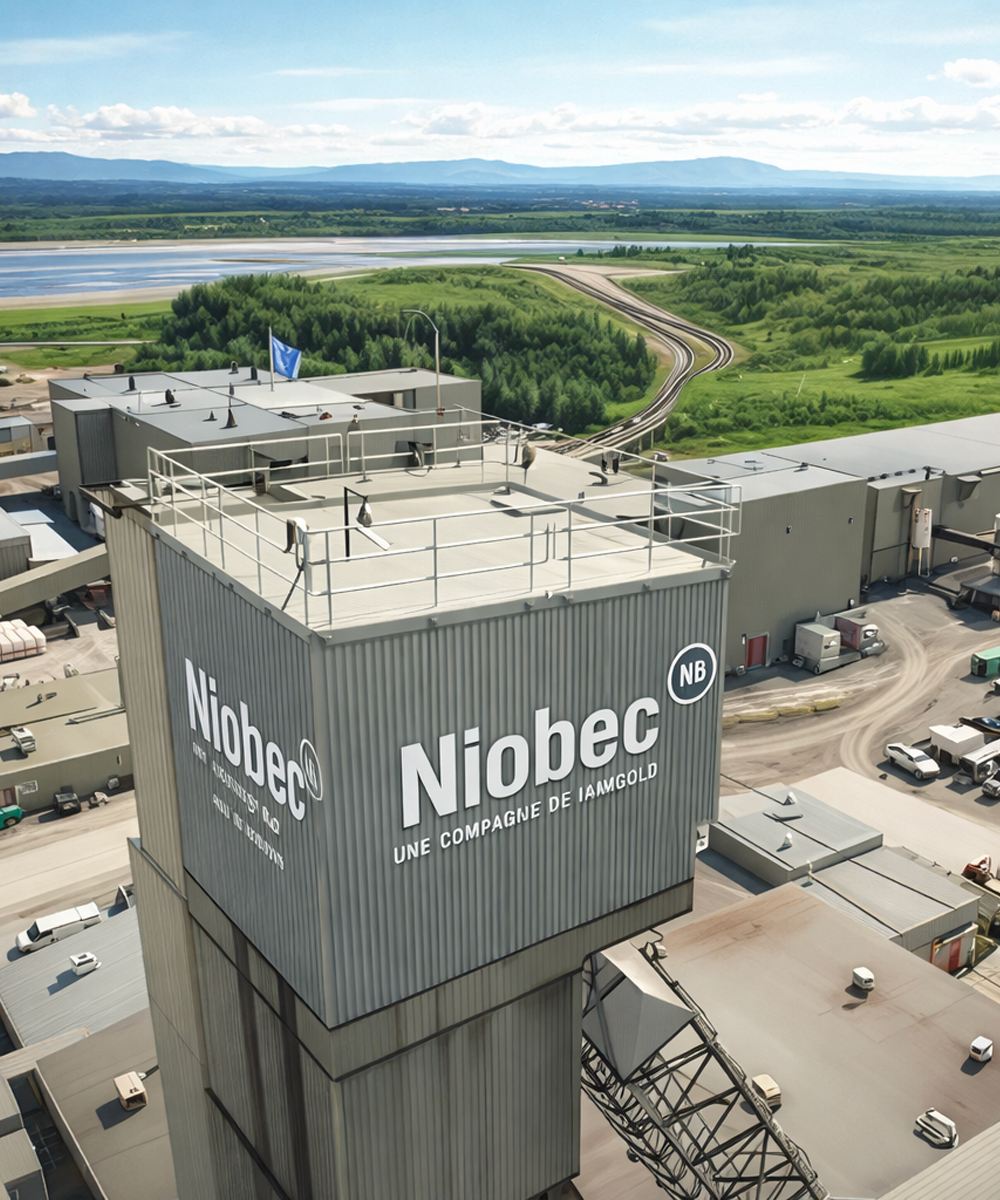
In early 2026, Magris Resources announced plans to expand Niobec's annual production from 2.2 million tonnes to 10 million tonnes over a 40-year mine life. That is a 4.5x increase. Over four decades. Announced in the same year the Iran war began depleting western munitions stockpiles and the critical minerals supply chain entered every major investor conversation simultaneously.
Private companies with perfect information about their own cost curves and their own demand visibility do not make this kind of commitment as a hedge or a PR exercise. They make it when they have stared at the demand projections and concluded that the market they are serving is going to be structurally larger for the rest of their investment horizon. Magris paid $530 million for Niobec in 2015. They are now committing hundreds of millions more to expand it nearly 5x. That is the single most credible demand signal available for niobium in a secure western jurisdiction — and it came from the people who know this asset better than anyone on Earth.
The New Demand Driver
The Niobec expansion was announced into a demand environment that did not exist at the time of the 2015 acquisition. The commercial space economy was a concept in 2015. In 2026, it is a structural growth industry backed by Wall Street consensus forecasts and accelerating launch cadences that are adding new niobium demand vectors that have no historical precedent.
The connection is material and specific. C-103 — a niobium-hafnium-titanium refractory alloy — is the material of choice for rocket engine nozzles because it combines a melting point of 2,477°C with structural integrity under sustained thermal loading. SpaceX uses it in the Merlin Vacuum engine nozzle on the Falcon 9. The Apollo 15 Service Module used a niobium-titanium alloy. These are not historical curiosities — they are active specifications on the most-launched rockets in human history.
At Mach 5 and above, the aerodynamic friction of hypersonic flight generates heat that destroys titanium, compromises steel, and melts aluminum. Niobium alloys are the only materials that survive. This is why C-103 appears in both the rocket nozzle pointed at orbit and the hypersonic missile pointed at a target — the physics are identical, the material solution is the same, and the supply chain is a single point of failure.
As SpaceX's launch cadence scales — and as competitors including Blue Origin, Rocket Lab, ULA, and international programs add to the global launch count — each launch is an irreplaceable niobium consumption event. The space economy does not substitute away from niobium. It compounds demand for it.
Quebec is not merely geographically convenient for a niobium project. It is operationally adjacent to one of the world's most concentrated aerospace manufacturing ecosystems. Quebec ranks alongside Seattle and Toulouse as one of the world's top three aerospace manufacturing hubs. Pratt & Whitney Canada, Bombardier Aerospace, GE Aviation, Bell Helicopter, and Lockheed Martin all operate in the province. The end users of niobium alloys are an hour from the Shipshaw Property. No remote greenfield project anywhere in the world can make that statement.
Geopolitical Context
China Spent 15 Years Buying the Mines. The West Is Just Waking Up.
The strategic urgency around western niobium supply did not emerge from a policy paper. It emerged from a sequence of transactions that occurred quietly over fifteen years while most investors were not paying attention.
1959 Last year of US domestic niobium production. No American mine has produced a tonne since. The United States has been 100% import dependent for 65 years.Source: USGS MCS 2025.
2011 A Chinese state consortium — CITIC Group, Baosteel, Ansteel, Shougang, and Taiyuan Iron & Steel — pays US$1.95 billion for a 15% stake in CBMM, the world's largest niobium producer controlling 82% of global supply. CITIC's own investor materials state: "Niobium is critical to the national economy and defense." Almost no Western media coverage.Source: CITIC Metal investor page.
2016 China Molybdenum (CMOC) acquires Anglo American's Catalão and Boa Vista niobium mines outright for US$1.5 billion — making China the direct owner of the world's second-largest niobium operation. Again: almost no mainstream coverage.Source: Anglo American press release.
2024 CSIS publishes Hypersonic Hegemony — warning that China's growing control over Brazilian niobium risks putting the United States on the back foot in hypersonic missile technology. USGS ranks niobium second most critical of 50 strategic minerals.
2026 54-nation Critical Minerals Ministerial in Washington DC. Eleven bilateral supply agreements signed in a single day. The DoD issues RFIs for domestic critical mineral supply on February 27 — the day before Iran strikes begin. Munitions expenditure accelerates restocking requirements. Niobec announces its 40-year expansion. NiobiumX is drilling the only adjacent carbonatite ground in North America.
The result of this sequence is a supply chain where Brazil produces 92% of global niobium, China controls approximately one-third of that Brazilian production through direct ownership and strategic stakes, and the United States produces zero. The only operating alternative at scale is Niobec — which just committed to 40 more years of production — and the only exploration-stage project in the same geological complex is the Shipshaw Property.
The Investment Case
What Niobec Means for Shipshaw
01 Geological Validation — CONFIRMED
Niobec proves the Saint-Honoré Alkaline Complex hosts economic-grade niobium mineralization. DIOS Exploration drilled 23 holes across the Shipshaw Property between 2010 and 2011. Every single hole intersected carbonatite — the host rock that contains both the Brazilian deposits and Niobec itself. 100% hit rate. The geological thesis is not speculative. The only open question is grade and continuity at depth — which is what Phase 1 fieldwork answers.
02 The Depth Arguement — Untested Ground
The Niobec ore body starts at 90 metres depth and runs to 720 metres and beyond. The DIOS historical drilling at Shipshaw was largely shallow — most holes between 15 and 60 metres. The most prospective part of the carbonatite system — the zone where Niobec's ore actually sits — has not yet been drilled at Shipshaw. Historical intercepts showing 3.70% TREEO are from peripheral material above the main zone.
03 Infrastructure — No Greenfield Premium
Road 172 provides year-round access. Rio Tinto's deepwater port at La Baie and CN railway infrastructure already service the district. Hydroelectric power — among the cheapest in North America — is on the grid. Niobec's on-site processing facility sits 5 kilometres away. A future Shipshaw producer inherits 50 years of built infrastructure that a remote project in a frontier jurisdiction could never replicate.
04 M&A Precedent — Hard Price Discovery
The $530 million Niobec transaction is not a soft comparable — it is hard price discovery for niobium in this exact jurisdiction. The buyer structured in a 2% REE royalty on adjacent ground and paid $30 million contingent on adjacent REE production. The smart money already valued the surrounding district. NiobiumX holds that surrounding district at a ~US$9 million market cap.
05 REE District Optionality
Niobec hosts more than 1,000 tonnes of rare earth element resources at 1.75% TREO — an exceptionally high grade. The 2015 transaction explicitly included the adjacent REE property and structured royalty payments around its production. Shipshaw's historical drilling returned REE grades up to 3.70% TREEO — above Niobec's own resource grade. The REE optionality is not incidental. It was the reason the transaction included a royalty.
06 Space Economy — New Demand Vector
At the time of Niobec's 2015 sale, the commercial space economy was nascent. Today, Morgan Stanley projects it reaching $1.1 trillion by 2040 — with every launch vehicle requiring C-103 niobium alloy in its nozzle. Quebec's aerospace cluster — Pratt & Whitney, Bombardier, GE Aviation, Bell Helicopter — sits an hour from Shipshaw. The downstream customers for a future niobium producer are geographically adjacent.
Technical Foundation
Independent Technical Validation: The NI 43-101 Conclusion
On February 17, 2026, Bertrand Brassard, M.Sc., P.Geo., OGQ (#1067) — an independent Qualified Person with 35 years of experience in mineral exploration — completed a NI 43-101 Technical Evaluation Report on the Shipshaw Property. His conclusion was unambiguous: the property warrants systematic exploration to evaluate its niobium and REE potential.
Brassard's recommended program:
- Phase 1 — reinterpretation of all historical drilling and geophysical data, followed by high-resolution ground magnetic and radiometric surveys to identify priority targets.
- Phase 2 — diamond drilling to test mineralized zone continuity at depth, specifically targeting the depth range where the Niobec ore body is widest (200–300 metres).
The QP's review is independent technical validation of a geological thesis, not a management promotional claim. His positive conclusion — based on 23 historical drill holes all intersecting the correct host rock, a low-magnetic geophysical anomaly mirroring Niobec's signature, and proximity to a 50-year producing mine in the same complex — provides the technical foundation for the Phase 1 program now underway.
The Case
In 2011, China paid $1.95 billion for a stake in the world's largest niobium producer. In 2016, it bought the second-largest outright. The United States has produced zero domestic niobium since 1959 — and every rocket nozzle in the commercial space race, every hypersonic missile in the defense restocking queue, and every quantum computer under construction requires a metal that China increasingly controls.
The only operating western alternative is Niobec. NiobiumX holds 48 claims spanning approximately ~2,630 hectares in the same carbonatite complex, surrounding Niobec. The processing infrastructure sits next door. The strategic buyer already exists. The only question is what Phase 1 finds at depth.
Disclosures
Important Disclosures: Historical exploration results for the Shipshaw Property were generated by DIOS Exploration Inc. (2010–2011) and have not been independently verified by NiobiumX Exploration Corp. or its Qualified Person. No mineral resource or mineral reserve estimate has been defined for the Shipshaw Property in accordance with NI 43-101 standards. Readers are cautioned not to place undue reliance on historical exploration results as they may not be indicative of future results. The Niobec Mine, operated by Magris Resources, is a separate property and its geological characteristics are not necessarily indicative of mineralization on the Shipshaw Property. This document contains forward-looking statements and information. Such statements involve known and unknown risks and uncertainties. Investing in junior exploration companies carries significant risk including total loss of capital. This document does not constitute investment advice. All dollar figures in USD unless otherwise noted. Market capitalization figures are approximate and subject to change. Space economy projections sourced from Morgan Stanley, Goldman Sachs, Bank of America, and US Chamber of Commerce research — for informational purposes only.