Introduction
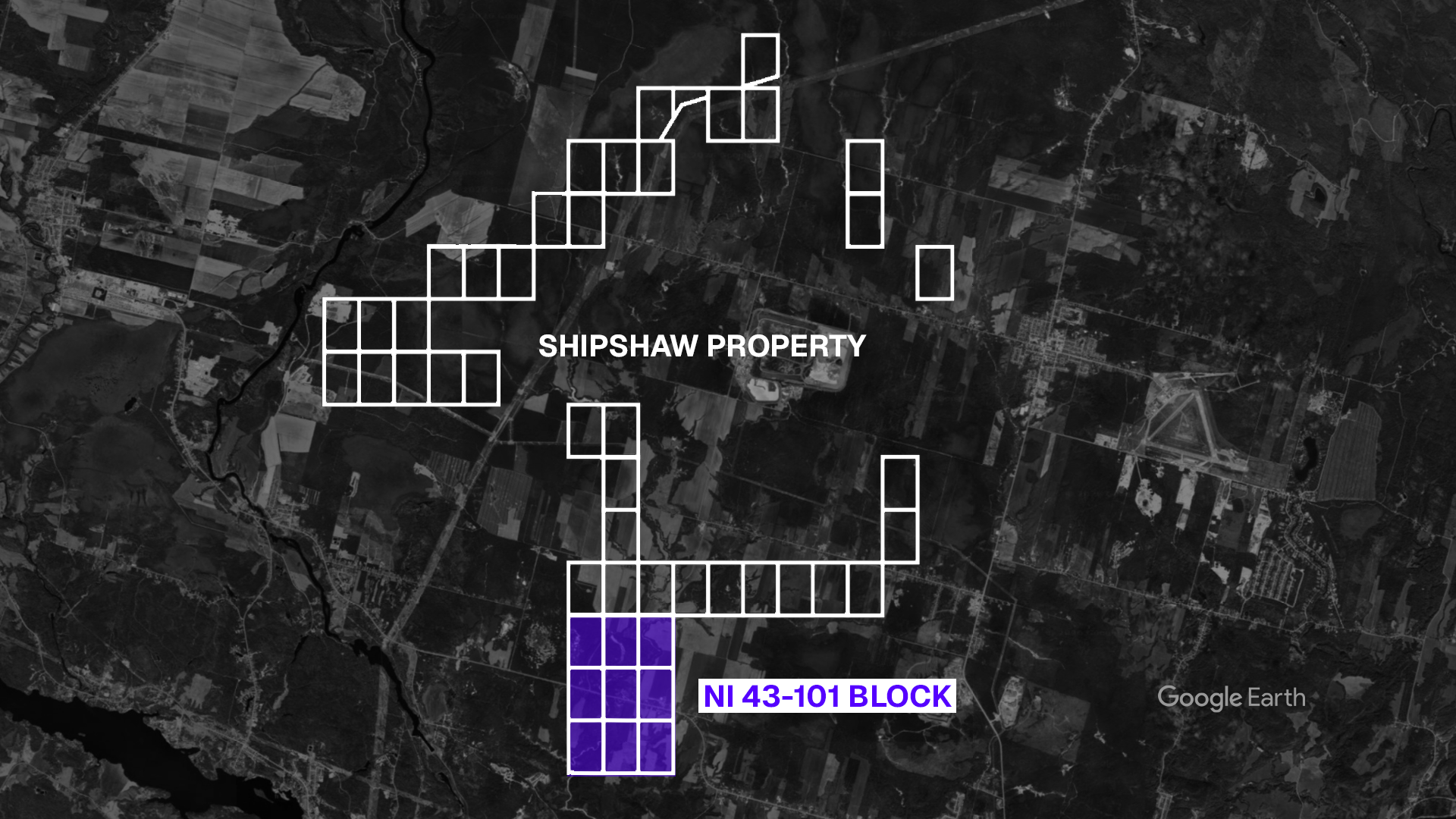
The current NI 43-101 technical report for the Shipshaw Property covers 9 mineral claims totaling approximately ~513 hectares.
Beyond the scope of this report, the Company has significantly expanded its land position to include an additional 39 contiguous claims totaling approximately ~2,120 hectares, bringing the total consolidated land package to 48 claims spanning approximately ~2,630 hectares.
This expanded footprint positions the Shipshaw Property as one of the most strategically assembled land packages in the district, surrounding and extending beyond the historically productive core.
The information below is derived from the NI 43-101 technical report available for download on this page.
Executive Overview
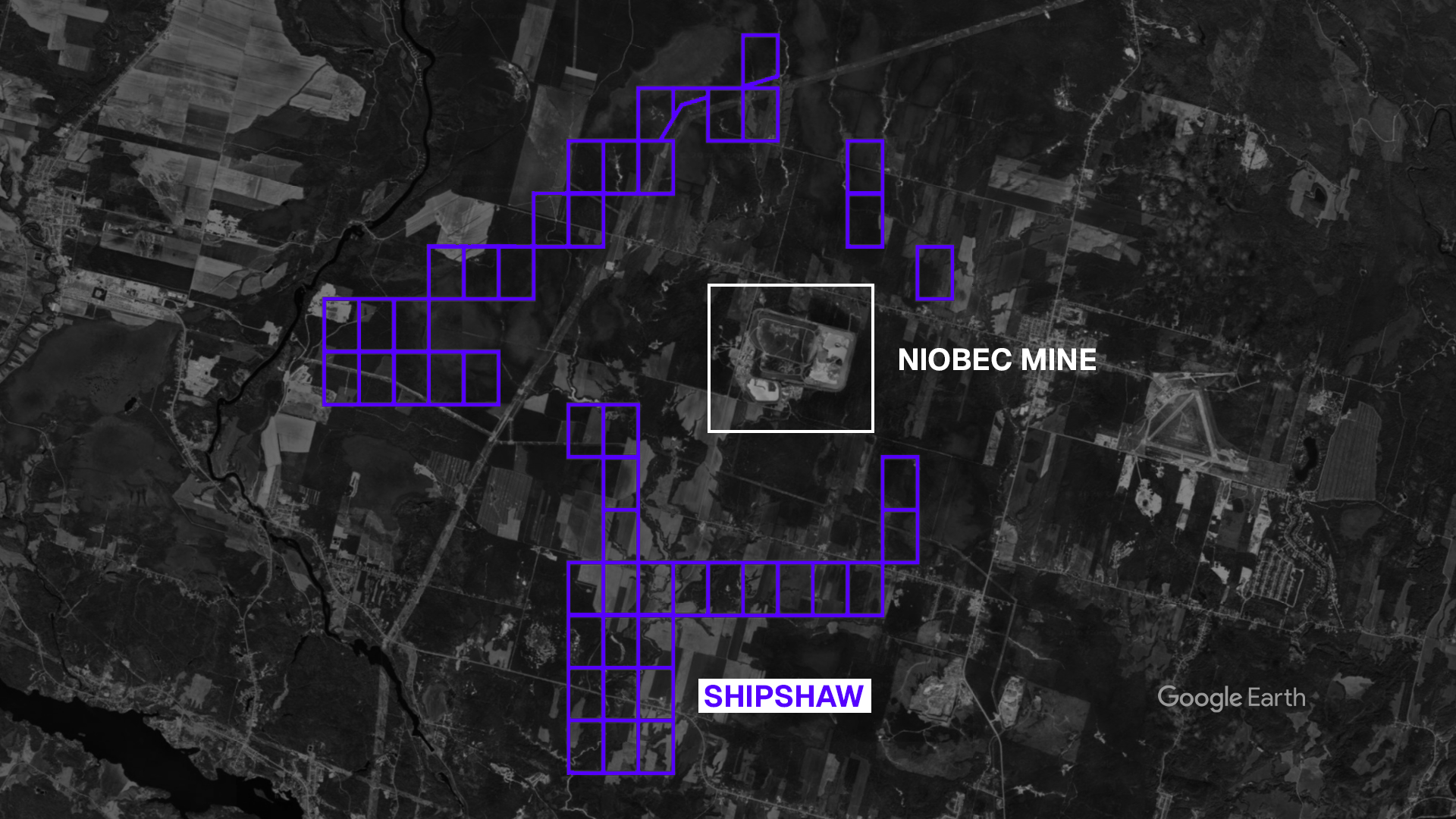
The Shipshaw Project is an early-stage rare earth element (REE) and niobium exploration property located in the Saguenay region of Québec, Canada, one of the most mining-friendly jurisdictions globally. The property surrounds the Niobec Mine, one of the world’s few operating niobium mines.
Historical drilling and geophysics indicate that the property hosts carbonatite-related mineralization, the same deposit type responsible for many of the world’s major rare earth and niobium deposits. Several drill holes from prior exploration campaigns intersected REE mineralization up to 3.7% TREE (Total Rare Earth Oxides) in carbonatite units, along with anomalous niobium values.
The project currently has no defined mineral resource, but existing drilling and geophysical anomalies suggest a potentially significant mineralized system that remains largely underexplored.
Project Location
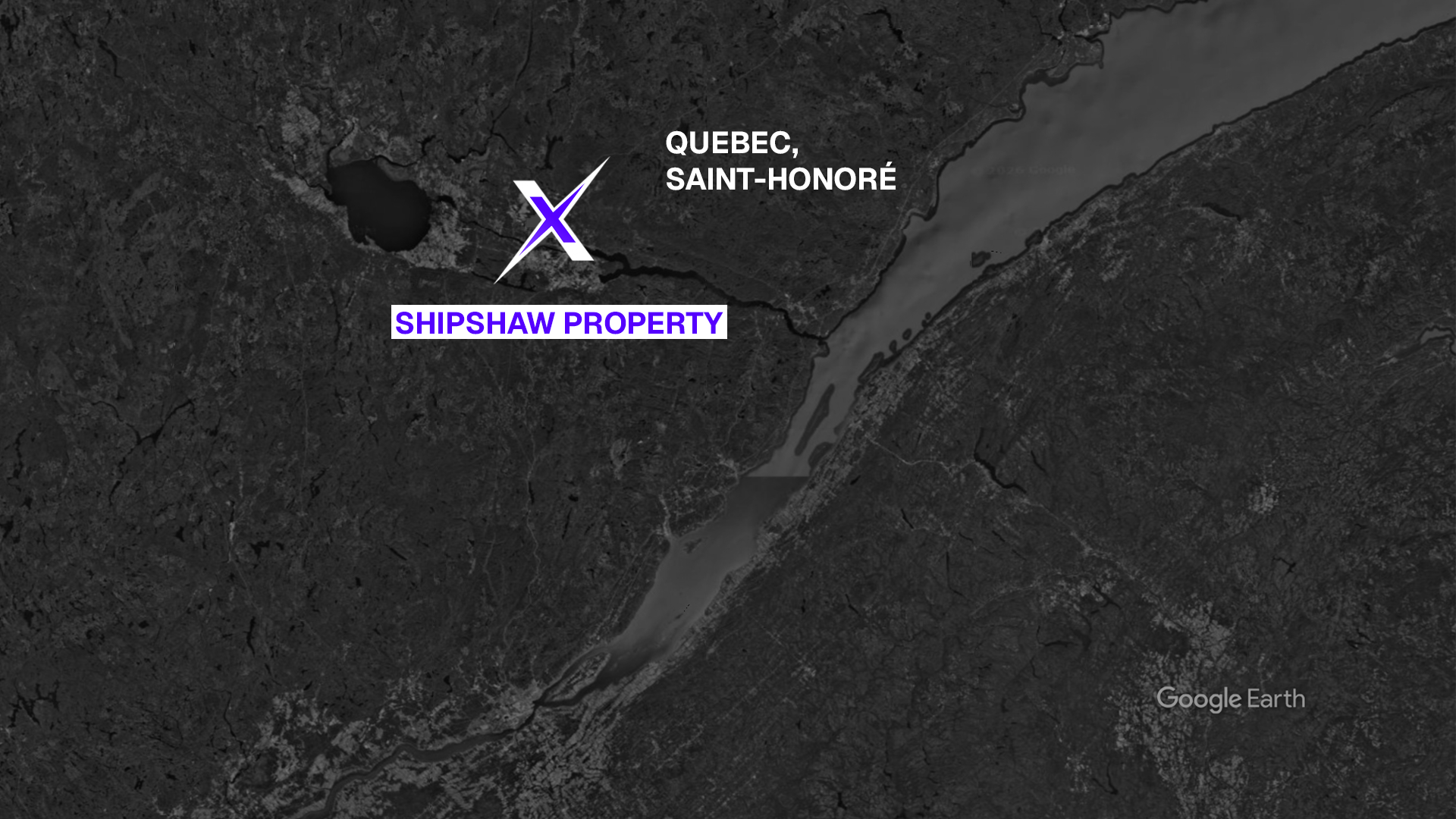
The Shipshaw Property, located near Saint-Honoré within the Niobec Mine district in Quebec, represents a consolidated land package strategically surrounding one of the world’s only producing niobium operations. The current NI 43-101 covers 9 contiguous mining claims totaling approximately 513 hectares; however, the Company has significantly expanded its footprint with an additional 39 contiguous claims comprising roughly 2,120 hectares. In total, the property now consists of 48 claims spanning approximately 2,630 hectares, forming a dominant land position encircling the Niobec Mine in Quebec, Canada.
Key advantages of the location include:
- Direct road access via Route 172
- Proximity to major mining infrastructure
- Access to skilled labor from the Saguenay mining district
- Nearby port at La Baie for mineral shipping
- Extensive hydroelectric power in the region
These factors significantly reduce development risk compared with remote exploration projects.
Strategic Geological Setting
The project lies within the Grenville Province of the Canadian Shield, an area known for alkaline intrusive complexes and carbonatite-hosted mineralization.
Key geological features include:
- Proximity to the Saint-Honoré Alkaline Complex
- A regional structure known as the Saguenay Graben
- Presence of carbonatite and lamprophyre dykes
- Host rocks including anorthosite, monzonite, and limestone
Carbonatites are globally important because they host many of the world’s:
- Rare earth deposits
- Niobium deposits
- Phosphate deposits
Exploration History
Exploration of the area dates back to the discovery of the Niobec deposit in 1967 during airborne geophysical surveys conducted by SOQUEM.
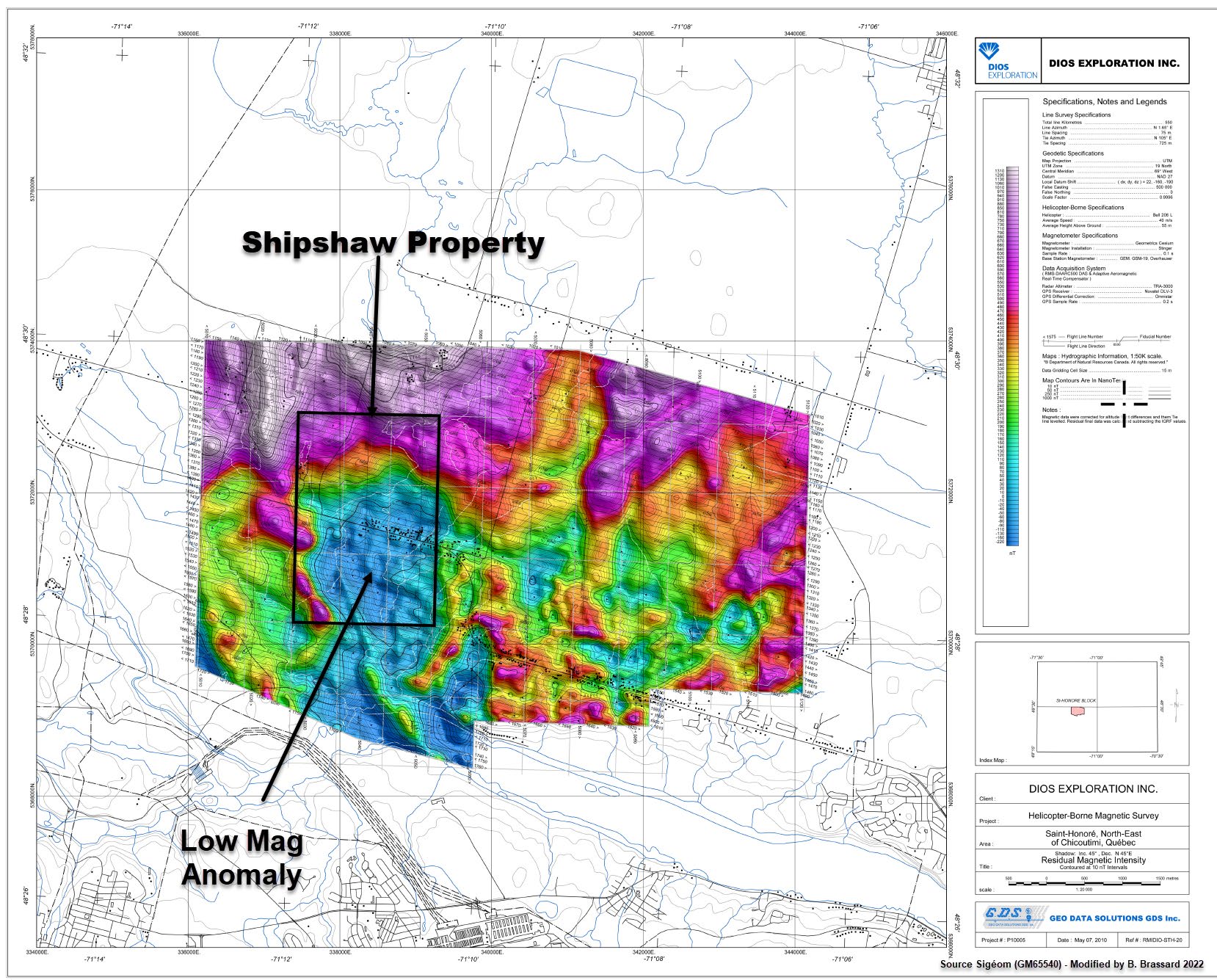
The Shipshaw anomaly itself was later identified during reinterpretation of regional magnetic surveys in 2010.
Key exploration milestones:
2010
- Heliborne magnetic survey identified a large low magnetic anomaly
- Anomaly comparable to the Niobec carbonatite signature
2010–2011
- 23 diamond drill holes
- 4,340 meters of drilling completed
All drill holes intersected portions of the carbonatite intrusive complex.
Mineralization
Mineralization occurs primarily in carbonatite and syenite intrusive rocks.
Main metals of interest:
- Rare Earth Elements (REE)
- Niobium (Nb)
- Tantalum (Ta)
- Phosphate (P₂O₅)
Carbonatite systems often host minerals such as:
- Pyrochlore (niobium)
- Bastnäsite (rare earths)
- Monazite (rare earths)
Drill Results Highlights
Historic drilling at the Terres Rompues zone returned several encouraging results.
Notable intercepts include:
Rare Earth Oxides (TREE)
- 3.7% TREE over 0.24 m
- 1.1% TREE over 0.8 m
- 0.70% REE over 1.7 m
- 0.49% REE over 3.3 m
Wider Mineralized Intervals
- 0.24% REE over 33.5 m
- 0.25% REE over 12.65 m
- 0.35% REE over 10 m
These grades confirm the presence of rare earth enrichment within the carbonatite system, although additional drilling is required to define continuity.
Historical REE drilling results at Shipshaw
DIOS Exploration drilled 23 holes between 2010 and 2011, totalling 4,340 metres of core. Every single hole intersected carbonatite, the same host rock that contains both the Brazilian niobium deposits and Niobec itself. That is a 100% hit rate on the right geology.
The REE-specific intercepts:
- DDH 773-01 returned 3.70% TREEO over 0.24m as the peak grade, which broke down as 0.99% lanthanum, 1.67% cerium, and 0.59% neodymium. The same hole returned a broader 0.27% TREEO zone over 12.27m, plus 6.3 g/t silver over 12.56m.
- DDH 773-05 returned 0.24% REE over 33.5m (the widest interval), including 0.30% REE over 16.0m.
The 3.70% TREEO peak grade at Shipshaw is higher than the 1.75% TREO grade of Niobec's own REE resource.
The Depth Argument
This is the most important context for the historical results. The DIOS drilling at Shipshaw was largely shallow, with most holes between 15 and 60 metres. The deepest hole reached only 110.8 metres.
By comparison, the Niobec ore body starts at 90 metres depth and runs to 720 metres and beyond. The case study argues that the 3.70% TREEO intercepts at Shipshaw came from peripheral material sitting above the main zone, and that the most prospective part of the carbonatite system, the depth range where Niobec's actual ore sits, has not yet been drilled at Shipshaw.
Geophysical Target
The main exploration target is a low magnetic anomaly identified through airborne magnetic surveys.
Low magnetic anomalies often indicate:
- Carbonatite cores
- Altered intrusive systems
- Rare earth enriched zones
The anomaly at Shipshaw has not yet been fully drilled.
Comparison to Nearby Deposits
Niobec Mine (Surrounded by Shipshaw)
- One of the largest niobium mines outside Brazil
- Produces niobium pentoxide concentrate
- Discovered using similar geophysical signatures
- The nearby Niobec Mine was acquired for approximately US$530 million by former Mark Bristow–led interests, highlighting the strategic value of this district.
Crevier Project
- Located ~70 km away
- Resource estimate:
Indicated: 25.8 Mt @ 0.186% Nb₂O₅
Inferred: 16.9 Mt @ 0.162% Nb₂O₅
These nearby deposits confirm that the Saguenay region hosts economically viable carbonatite systems.
Recommended Exploration Program
The NI 43-101 report recommends a two-phase exploration program.
Phase 1
- Locate historic drill core
- Re-assay mineralized zones for TREE
- Reinterpret geological sections
- Advanced geophysical modeling
Phase 2
- Follow-up drilling
- Test geophysical anomalies
- Delineate mineralized bodies
Investment Thesis
Prime Mining Jurisdiction
- Québec ranked among top global mining jurisdictions
Tier-1 Geological Setting
- Located next to the Niobec carbonatite complex
Underexplored Carbonatite System
- Carbonatites are the primary host for REE and niobium deposits globally
Historic High-Grade REE Intercepts
- Up to 3.7% TREE
Excellent Infrastructure
- Roads, power, labor, and port access nearby
Key Catalysts & Key Risks
Key Catalysts:
- Re-assaying historical drill core
- Updated geological modeling
- Identification of new drill targets
- New drilling campaign
- Potential maiden resource estimate
Key Risks:
- Early exploration stage
- No defined resource
- REE market volatility
Conclusion
The Shipshaw Project represents a high-potential carbonatite exploration target located in a prolific mining district in Québec. Historical drilling has confirmed the presence of rare earth and niobium mineralization within a large geophysical anomaly that remains insufficiently tested.
Given its proximity to the Niobec Mine, similar geological setting, and historical rare earth intercepts, the project warrants further exploration to determine whether the carbonatite system hosts an economically significant mineral deposit.